
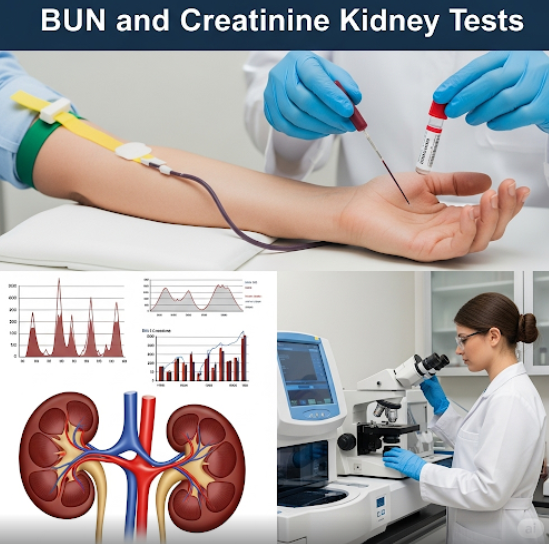
Overview of the BUN and Creatinine Kidney Tests
The Blood Urea Nitrogen (BUN) and Creatinine tests represent two of the most fundamental and routinely utilized blood analyses for the comprehensive assessment of kidney function. Both BUN and creatinine are distinct waste products, which, in a healthy physiological state, the kidneys efficiently filter out of the bloodstream and subsequently excrete from the body via urine. Specifically, Blood Urea Nitrogen (BUN) is a metabolic waste product generated within the liver as a result of protein breakdown. Once formed, it is transported through the blood circulation to the kidneys, where its primary fate is filtration. Conversely, Creatinine is a waste product that arises from the normal metabolism occurring within muscle tissue. Its production rate is generally stable, correlating directly with an individual's muscle mass, and it is freely filtered by the kidneys. Given that both BUN and creatinine are continuously produced and their primary route of elimination is through renal activity, their circulating levels in the blood provide invaluable insights into the efficiency of the kidneys' filtration capabilities. Elevated concentrations of either BUN or creatinine can serve as a critical indicator of impaired kidney function, signaling that the kidneys may not be effectively removing these waste products from the bloodstream as they should. These two tests are frequently measured concurrently, often presented as a "BUN/Creatinine ratio" or integrated into a broader comprehensive metabolic panel, to offer a more holistic and nuanced understanding of overall kidney health.
Why the BUN and Creatinine Tests are Done
The BUN and Creatinine tests are performed for several critical diagnostic and monitoring purposes, primarily to identify, track, and screen for kidney disease or various forms of renal dysfunction. Healthcare professionals frequently request these tests when a kidney problem is suspected, particularly if a patient presents with symptoms such as persistent fatigue, noticeable swelling (edema) in the lower extremities (legs or feet), alterations in typical urination patterns (e.g., increased or decreased frequency, foamy urine), muscle cramps, or episodes of nausea. These tests play a vital role in screening for kidney disease, often included as a standard component of routine health check-ups, especially for individuals recognized as being at elevated risk. This high-risk group encompasses patients with pre-existing conditions like diabetes, uncontrolled high blood pressure, established heart disease, or a familial history of kidney ailments. Moreover, abnormally elevated levels can signify either an acute kidney injury, characterized by a sudden decline in renal function, or the presence of chronic kidney disease, a more gradual and progressive loss of kidney function. For patients already diagnosed with kidney disease, these tests are instrumental in monitoring the progression of their condition and evaluating the effectiveness of ongoing therapeutic interventions. Additionally, BUN levels can be influenced by hydration status, thereby assisting in the diagnosis of fluid imbalances such as dehydration. Lastly, they help in assessing potential adverse effects on kidney function from certain medications known to have renal toxicity. By collectively providing an estimate of the kidneys' filtering capacity, these tests are indispensable tools for the early detection and proactive management of kidney disorders.
Risks
The risks associated with undergoing BUN and Creatinine tests are remarkably minimal, as the procedure is limited to a routine blood draw, medically termed venipuncture. These potential risks are typically minor, localized to the site of the blood collection, and transient. You may experience a brief, slight pain or a temporary stinging sensation when the needle is inserted into your vein. Following the blood collection, it is common for a small bruise to form at the puncture site; however, such bruising typically resolves spontaneously within a few days without necessitating any specific intervention. Some individuals, particularly those who are acutely sensitive to needles or possess a predisposition to fainting, might experience transient dizziness or a sensation of lightheadedness either during or immediately after the blood draw. In very rare circumstances, a small collection of blood under the skin, medically referred to as a hematoma, might develop if bleeding persists internally at the puncture site. The risk of developing an infection at the site of puncture is exceedingly low, provided that proper sterile techniques are meticulously adhered to by the healthcare professional performing the blood draw. While excessive bleeding from the puncture site is uncommon, it is a slight consideration for individuals who are currently taking anticoagulant (blood-thinning) medications. Overall, these potential complications are infrequent, generally mild in nature, and do not lead to any long-term health concerns, thereby classifying the BUN and Creatinine tests as very safe diagnostic procedures.
How You Prepare
Preparing for BUN and Creatinine tests is generally straightforward, although it is crucial to recognize that certain factors can influence the accuracy of the results. Therefore, adherence to specific guidelines provided by your healthcare provider is paramount. Typically, for a standalone BUN or Creatinine test, no fasting is usually required. This means you are generally permitted to eat and drink as you normally would before the blood draw. However, it is consistently vital to inform your doctor about all medications you are currently taking, which includes prescription drugs, over-the-counter remedies, herbal preparations, and any dietary supplements. This disclosure is essential because several medications, such as certain antibiotics (e.g., trimethoprim), specific diuretics, and non-steroidal anti-inflammatory drugs (NSAIDs), are known to affect kidney function or directly influence creatinine levels. Your doctor may, based on your medical history and current medications, advise you to temporarily discontinue or adjust certain medications; however, it is critical that you *never modify your medication regimen without their explicit instruction*. Furthermore, engaging in strenuous physical exercise just prior to the test can cause a temporary increase in creatinine levels. Consequently, it is advisable to avoid intense workouts or heavy lifting for at least 24 hours before your scheduled test. Similarly, consuming exceptionally large amounts of red meat or protein supplements shortly before the test might also exert an influence on both BUN and creatinine levels. Always adhere diligently to your healthcare provider's specific instructions to ensure the most accurate and diagnostically useful test outcome.
What You Can Expect
Before the Test
Before your scheduled BUN and Creatinine tests, your primary focus will be on meticulously adhering to any preparatory instructions provided by your healthcare provider. In most typical scenarios, these particular tests do not necessitate a fasting period, allowing you the flexibility to eat and drink normally before your appointment. However, it is always a prudent measure to explicitly confirm this with your doctor or the laboratory staff, especially if these tests are part of a broader blood panel that might have different preparation requirements. It is absolutely crucial to ensure that your doctor is comprehensively aware of all medications you are currently taking, which includes prescription drugs, over-the-counter medications, and any dietary supplements. This thorough disclosure is vital because certain medications possess the potential to influence BUN or creatinine levels, and your doctor may, in some instances, advise temporary adjustments to your medication regimen. Importantly, any such adjustments must *only* be made under their direct medical supervision. Additionally, it is generally recommended to refrain from engaging in strenuous physical activity for at least 24 hours prior to the test, as intense exercise has the capacity to temporarily elevate creatinine levels. On the day of your appointment, it is advisable to arrive at the clinic or laboratory feeling relaxed and adequately hydrated. If you tend to experience anxiety or discomfort related to blood draws, communicating this to the phlebotomist can be helpful, as they can then employ techniques to make the process as comfortable as possible for you. These meticulous preparatory steps are fundamental for safeguarding the integrity and ultimate accuracy of your test results, thereby ensuring that the blood sample collected genuinely reflects your true BUN and creatinine levels for proper clinical assessment.
During the Test
During the BUN and Creatinine tests, you will undergo a standard and typically swift blood collection procedure, medically referred to as venipuncture. You will be comfortably seated, usually in a specialized chair designed specifically for blood draws, allowing for easy access to your arm. A trained and qualified healthcare professional, such as a phlebotomist or a nurse, will meticulously examine your arm to identify a suitable vein. The most common site for blood collection is the crook of your arm (antecubital fossa), though occasionally, a vein on the back of your hand might be used. The selected area of skin will then be thoroughly cleansed with an antiseptic wipe. This crucial step is performed to maintain rigorous sterility and effectively prevent any potential infection at the puncture site. To make the chosen vein more prominent and easier to access for the needle, a tourniquet may be gently applied around your upper arm; this temporarily increases blood flow to the vein, causing it to swell slightly. Once the vein is adequately prepared, a sterile, single-use needle will be carefully inserted. You are likely to experience a brief, sharp prick or a mild stinging sensation as the needle penetrates the skin. Blood will then steadily flow into one or more small, designated collection tubes. The actual process of blood collection is remarkably swift, typically concluding within just a few minutes. After the necessary amount of blood has been obtained, the tourniquet is released, and the needle is smoothly withdrawn. Immediate pressure will then be applied to the puncture site using a clean cotton ball or gauze to stop any bleeding and minimize bruising.
Results
Following the collection of your blood sample for the BUN and Creatinine tests, it is promptly dispatched to a medical laboratory for precise and comprehensive analysis. Within the laboratory, specialized technologists will accurately measure the concentration of both Blood Urea Nitrogen and Creatinine present in your blood. Upon completion of the analytical process, a detailed report containing these crucial numerical values will be meticulously generated. These results are typically expressed in milligrams per deciliter (mg/dL) for both BUN and Creatinine and will then be securely transmitted to your healthcare provider, usually within a few days. Your doctor will then undertake the critical task of interpreting these results, assessing them in the context of established normal reference ranges. It is important to note that these normal ranges can exhibit slight variations among different laboratories due to varying equipment or methodologies. Generally, for adults, normal BUN levels typically range from 7 to 20 mg/dL, while normal creatinine levels commonly fall between 0.6 to 1.3 mg/dL. Critically, elevated levels of either BUN or creatinine can serve as a significant indicator of impaired kidney function, though they can also be influenced by factors like dehydration or certain other medical conditions. Your doctor will thoroughly discuss the findings with you, providing a clear explanation of what your BUN and Creatinine levels signify regarding your kidney health. Based on these results, along with the calculated BUN/Creatinine ratio and a comprehensive review of your complete medical history and current health status, your doctor will recommend any necessary follow-up actions. These may include further diagnostic tests to pinpoint the exact cause of any abnormalities, specific lifestyle modifications (such as dietary adjustments or fluid intake recommendations), or targeted medical treatments to address any underlying issues affecting your kidney function and overall well-being.